Friday, January 31, 2014

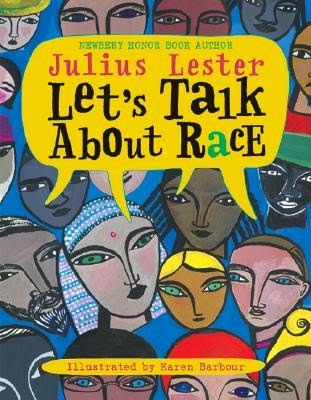
Let's Talk About Race by Julius Lester (Illustrated by Karen Barbour)


Published in 2005

Julius Lester's book Let's Talk About Race is a beautifully illustrated book that gets to the heart of an important issue that is often difficult to talk about: race. Lester handles the topic with sensitivity and speaks on a level that easily relates to children. Karen Barbour uses vibrant colors that are visually appealing and eye-catching for the cover and illustrations. The pages are colorful and smooth to the touch, very inviting. 

Lester begins his story by making it personal. The first thing you read when you open the cover are the words, "I am a story. So are you. So is everyone." Who can argue with this statement? We all have a story. We all have a time when we were born and a place where we were born. We all have parents, brothers, and sisters or other family members. Lester then tells his story and asks his readers to tell their stories. He draws in his audience by making his book relevant to them by asking, how does your story begin? He brings the topic of race down to a child's level. He says that all our stories have many of the same elements, such as our favorite foods, hobbies, colors, religions, nationalities, and our favorite time of day. 

After explaining what we all have in common, Lester makes the transition to race. He questions his readers about race and then questions whether what they think about race is true. The most powerful point Lester makes and the climax of the story is when he encourages his readers to discover what is beneath their skin. If we all took off our hair, our clothes, and our skin, we would discover that we all have one thing in common: a skeleton. We are all alike in this way: we all have bones.

Lester's book would be a safe way to discuss the issue of race with children.


Anne Frank's Chestnut Tree by Jane Kohuth (Illustrated by Elizabeth Sayles)


A Symbol of Hope
Anne Frank's chestnut tree before it fell down in 2010. 
Jane Kohuth's book Anne Frank's Chestnut Tree was published in 2013 and is a truthful biography of the story of Anne Frank's time spent in hiding in the secret annex in Amsterdam during World War II. Although the story provides information about Anne's life before her family went into hiding, the main focus of the story is on the chestnut tree that Anne could see from the attic window. The tree was very important to Anne, as she mentioned it several times in her diary. For her, it became a symbol of hope.

After standing for more than 150 years, the tree began to show signs of disease in 2005, and after extensive efforts were made to save the tree, the tree was blown down in a storm in 2010.

What happened to Anne's chestnut tree?
The Secret Annex
Anne's Chestnut tree in 2003.
In her book, Kohuth explains how the tree made Anne feel: "In the world around her, Anne saw fighting and fear. But in the blue sky above, she saw beauty and peace. So she climbed up to the attic. The windows there were not covered. Anne looked out and saw the tall chestnut tree. She felt the sun on her face. Seeing the tree and sky calmed Anne. It helped her feel brave. . . .She noticed the passing seasons by watching the chestnut tree grow buds and leaves. . . .Nature made Anne feel that God had not left her. She wrote in her diary, 'I firmly believe that nature can bring comfort to all who suffer'" (32-37).

Anne' Chestnut tree in 2006
Anne Frank's diary has been read by millions of middle school children around the world. Kohuth's book could be used to introduce her story to young children who are newly independent readers; however, young children would probably have difficulty understanding this book because they don't have prior knowledge of World War II and the Holocaust. This topic would best be shared with older children who are ready to understand the complexity of what happened during the war.

One problem I found with the book was the cover; I believe the illustrations on the cover and throughout the book would have been more effective if they had been realistic in their presentation. Although this is an important story that should be told, I believe the book could have reached a wider audience had the author written for young adults rather than young children. Realistic images would have provided credibility to the story.


Anne Frank's Official Website
Anne Frank's Tree Interactive
Anne Frank's Tree Falls Over
Image Source
Image Source for Kohuth's Book

Wednesday, January 29, 2014

Three Young Pilgrims by Cheryl Harness (Author and Illustrator)


Published in 1992

Cheryl Harness' book Three Young Pilgrims is a work of historical fiction that portrays the story of three children, Bartholomew, Remember, and Mary Allerton, who sailed from Southampton, England to Plymouth Rock on the Mayflower during the 17th century. The story begins with the children standing on the deck of "a little boat" and setting sail for the New World and concludes with the celebration of the first Thanksgiving. The final pages are dedicated to three groups of people who were involved in the story: the Pilgrims who left England to escape religious persecution, the Strangers who joined the Pilgrims because the New World offered the opportunity for people to own land, and the Indians who interacted with the Pilgrims after they landed on the shores of Plymouth Rock. None of the pages in this book are numbered.

Harness explains the purpose of the book in her author's note:

"The purpose of this book is to tell part of the story of a family. The Allerton's adventures, during one year, between the autumns of 1620 and 1621, cannot be told apart from the larger story of a group of brave people who set out to make a new life in a land that was unknown to them.

The book is not meant to be a scholarly work on the Pilgrims. Much has been written in greater detail about their ways and wanderings. It is, instead, a storybook, an illustrated primer that will, perhaps, lead the reader to further study.

While researching this story I visited Plimoth Plantation in Plymouth, Massachusetts. This living history museum strives to give an authentic simulation of how life was lived in the 1620s. It's a trip I would recommend to anyone who wants to discover more."

The illustrations in the book are filled with historical facts that are the result of Harness' extensive research. One page, in particular, shows a detailed view of how everyone on the ship lived above and below deck on the Mayflower; all the rooms are labeled. Maps are provided to show the route of their long, difficult journey to the New World. Although the journey was difficult, the Pilgrims believed the risk was worth taking because they wanted, more than anything, to live in a land free from religious persecution.

In a touching scene between the children and their father, Bartholomew ask[s], "Papa, are you happy we came to America?" Remember frowns at her brother because she doesn't want her father to be sad. The reader soon learns that their mother has died. 

After a time he say[s], "Your mother and I wanted to bring up our children where no king could tell us how to live and pray." He sigh[s], "We didn't know it would be so hard, but yes, I am happy. Mary wishes her "Mama were there," and "Papa's arms tighten around her."

The most amazing thing about this book is the historical information that is woven throughout the story of the three young Pilgrims. On one page, Harness provides a time-line that begins with Lief Ericson sailing to the New World in the year 1002 and ends with Captain Thomas Dermer coming to Capawack Island in 1620. On the sidebar of the same page, she lists other events taking place around the world at the time of the Pilgrims. Several examples include the plays of Shakespeare being published in England, Rembrandt painting in Holland, Louis XIII sitting on the throne in France, Opera being invented in Italy, the Ming dynasty of emperors beginning in China, and the first Romanov czars ruling Russia. I found the side notes fascinating, as well as enlightening.

This book would be great to read to younger children around Thanksgiving time, but it would also be valuable for young adults to read because of the historical information. It is fitting that Harness dedicates her book to the Pilgrims and the staff of Plimoth Plantation and acknowledges the life and writing of William Bradford.
  

Monday, January 27, 2014

Diary of A Wimpy Kid: The Ugly Truth by Jeff Kinney (Author and Cartoonist)


Published in 2010

I can understand why Jeff Kinney’s book Diary of a Wimpy Kid: The Ugly Truth made the New York Times Bestseller list and is so popular among middle school students. At first glance, a reader can see that the book would be visually appealing to young people because it is a graphic novel.  The book is written in first person point-of-view from Greg Heffley’s perspective. The cover and binding look like a diary or a spiral notebook, but Greg insists it is a “journal.” The illustrations are drawn in a cartoon format, and the pages are lined like notebook paper. The book is divided by months and days, rather than by chapters, and the words appear to have been written by a young child. The book is an easy read because of the many illustrations and large font size; I read it in one sitting. I have to admit this is one of the funniest books I’ve read in a long time.  I can’t wait to read more of Kinney’s books! I highly recommend that adults take the time to read the Diary of a Wimpy Kid series because it really does give a humorous glimpse into the mind of a middle-school-age child.

Greg Heffley, the protagonist, is worried about the same things we all worried about or experienced when we were that age: our appearance, our friends, and the crazy antics that often involve family get-togethers. In this book, the family get-together involves Greg’s Uncle Gary’s FOURTH wedding, and he has had to take part in "every single one of them!" He can’t understand why there’s all the fuss; next year will be Uncle Gary’s FIFTH wedding. But the funniest anecdote is when Greg’s school announces there will be a special fund raiser for the music program at their school, a lock-in. I guess this one appealed to me because I’m a teacher, and I could visualize something like this actually happening.

Greg thinks it’s going to be great because boys AND girls will be there. However, when he checks in, he notices there’s “at least one adult for every kid,” and there’s not many girls at the lock-in at all. It’s not quite what he expects. One thing leads to another, and the adults can’t get the kids to participate in the activity center because everyone is listening to their electronic gadgets. This is a realistic portrayal of young people today! All the cell phones and electronic devices are confiscated, and this causes a major uproar later because the parents can’t get in touch with their children. Throughout the evening, there are several misunderstandings between the adults and kids, but the funniest thing happens when they are persuaded to be “social” and play a game.

Here’s Greg’s explanation of how the game is supposed to work: Each team has to go into another room and take a picture of one of its members. But the picture has to be a close-up, like an ear or a nose or a hand or something like that. Then each team will bring their picture to the library, and the other teams will have to guess who is in the picture. The winning team will get ice cream sandwiches (Kinney 66-67).

The boys are disappointed when they are handed old-fashioned instant cameras because “they don’t have a screen or anything” (Kinney 145). Greg’s team then goes off to the science lab to take their picture. They go back and forth trying to decide who and what part of the body to photograph. Is this really something you want to tell a group of middle school boys to do? Finally, they decide to take a picture of Tyson Sander’s bent arm, and they walk proudly back to the auditorium to win their prize. When the adults see the photograph they misinterpret it as someone’s “posterior,” become angry, and threaten to call their parents to take them home. The boys don't know what the word posterior means. Mr. Tanner says the one "whose butt [is] in the picture [is] going to REALLY be in trouble" (Kinney 151)! The kids run because they fear a “butt lineup” to try to catch the culprit.

Finally, Mr. Tanner listens to the boys’ story and compares the photo with Tyson’s arm and all is resolved. It was all just a simple misunderstanding. The entire book is filled with misunderstandings like this one between adults and kids that, I believe, both can relate to and will enjoy! I highly recommend this book not only for middle school students but for adults as well.

There’s one journal entry I have to comment on before closing. Greg is struggling with math. He says, “This math thing is becoming a problem. We have ‘standardized testing’ coming up at my school, and I heard that the teachers won’t get their bonuses unless we get good scores. So there’s a lot of pressure on us kids, which kind of stinks. I remember back in kindergarten, math used to be really FUN” (Kinney 66). Bonuses? What’s a bonus? Mr. Kinney, where did you ever get this idea for your book?
I absolutely loved Diary of a Wimpy Kid: The Ugly Truth!

Saturday, January 25, 2014

The Arrival by Shaun Tan (Author and Illustrator)


Published in 2006

Shaun Tan's book The Arrival is one of the most beautifully illustrated books I've ever read, but as far as the story goes, there were too many allusions that I just didn't understand. I read the book with no prior knowledge about Shaun Tan and his work, so I feel I need a little help to truly appreciate his work. I understood the basic plot about immigrants coming to this country, but I didn't really understand all the strange creatures that appear throughout the story. I wasn't sure whether the story was serious or humorous. I found it rather confusing.

I appreciate Tan's note at the end of the story that explains several scenes regarding the sinking of the Titanic in 1912 and Ellis Island, but I felt like I needed words to connect me with the images. I enjoyed perusing Tan's website more than reading (looking?) at his book.

Shaun Tan's Website
Image Source

Alligator Boy by Cynthia Rylant (Illustrated by Diane Goode)


Published 2007

I didn’t quite know what to think about Cynthia Rylant’s book Alligator Boy. As I read this seemingly whimsical story about a boy who is “tired of being a boy” and “wants to be somebody new,” I became confused and somewhat concerned.  I had difficulty trying to figure out the theme or purpose of the book. Is this just a book trying to teach children to accept themselves unconditionally, or does she have a deeper message she is trying to convey?

A boy, who isn’t named and could represent any boy, explains his dilemma to his auntie who lives far away. He’s tired of being a boy and wants to be somebody new.  Auntie responds by sending him “a rather big box” which contains an alligator suit. The boy puts on the suit and becomes “quite a fine alligator.” Alligator boy then reveals to his father his sudden, dramatic change and says, “I hope you still like me.”  However, when he reveals his new identity to his mother, she responds with fear, puts her son to bed right away, and calls the doctor. The doctor “not having studied green reptiles just yet” says she must call in a vet, which I thought was rather strange, but humorous. The vet’s advice to the mother is “just feed it each day and teach it to spell.” It?

Alligator boy enrolls in school with his new identity, gets past the school bully, and “enjoys the student life fully.” The expressions on the children’s faces in the illustrations are funny, blank stares, kind of how I felt reading the story. And what is the point?

In the end, alligator boy succeeds in school by cleaning the erasers, dusting them, and saving his friends with a big, scary roar. Rylant describes alligator boy as quite happy and joyful as he embraces his new identity. In the final illustration, mother and alligator boy are depicted in a loving embrace while sitting in a chair. I guess she becomes enlightened, realizing that her son’s wish to change his identity is normal. The book’s final message? “What a good green life for an alligator boy.” Strange story.

Image Source
Images for Alligator Boy

An Angel for Solomon Singer by Cynthia Rylant (Illustrated by Peter Catalanotto)


Published 1992

Cynthia Rylant’s book An Angel for Solomon Singer is a sentimental story about a man named Solomon who is unhappy in his present living condition. He lives in a hotel for men near the corner of Columbus Avenue and Eighty-Fifth Street in New York City.  He laments that his room has none of the things he loves, a balcony, a fireplace, a porch swing for napping, a window where he can watch birds, a cat or a dog, or yellow walls. Solomon Singer becomes a wanderer because he doesn’t like his current living situation.

One day he wanders into the Westway Café where he meets a friendly waiter named Angel who welcomes him with open arms and becomes his friend.  After nightly visits to the café, Solomon is reminded of his home in Indiana where he grew up as a boy and begins to feel like he has found a home once again. In the end, Solomon’s life doesn’t change much and, I suppose, is reflective of many people living in his situation. Solomon, at one point in the story, even sneaks a cat into his room which is against the rules. What kind of message does this send to children? Will this really make him happy?

However, even though the story is realistic and is beautifully illustrated, I found it rather depressing.  I was hoping for a more encouraging ending, especially since the waiter’s name was Angel. I was hoping for a miracle. I guess, in a way, one did happen in that Solomon found a place where he felt he belonged, but I was hoping Angel would inspire Solomon Singer to do something to change his life circumstances.

I would like to see stories written that encourage children to change their circumstances by getting an education and by working hard, by taking action. Becoming a wanderer and lamenting about current circumstances will not result in positive life change. Breaking rules only leads to anxiety. In real life, Solomon would find himself living in constant fear that someone would discover he has brought a cat into the hotel, and he could lose his room altogether. What good would that do him?

Determination, perseverance, and personal responsibility are what change life circumstances, and individuals can change their lives if believe in themselves and their abilities. Remember "Yes We Can!" How this acclamation rings hollow now. Oh, I forgot; the government is the answer to all our problems. What would have happened to me and my children if I had chosen to wander around lamenting about my present circumstances when my husband was diagnosed with cancer? This thought terrifies me!

Image Source